
· by Michael Blair, Nashville's Irrigation
When a homeowner calls about a sprinkler system that is not working right, the problem is usually not the controller or the valves. It is a handful of heads: one snapped by a mower, one that never pops up, one leaning toward the street, one buried under a season of thatch. Each is a small part, but each one changes where the water lands for everything around it. Here is what our crews find when they walk a zone on a sprinkler repair call, and what it takes to fix a head so it stays fixed.
The heads we find on a repair call
We run each zone and walk it head by head, because the failures look different from the kitchen window than they do standing over them. A broken head is the obvious one: a cracked cap or a body sheared off at the riser, usually by a mower wheel, a truck backing onto the lawn edge or a plow on a corner lot, and it shows up as a geyser or a gurgling puddle instead of a spray. A stuck-down head rises a little or not at all, because grit has jammed the stem, the wiper seal is worn, or the zone does not have the pressure to lift it.
A tilted head throws its water up into the air on one side and into the turf on the other. In our clay, which swells when wet and shrinks and cracks in a dry August, heads lean a little more every year. A buried head is one the lawn has grown over, with thatch and soil built up around the cap until the spray hits a wall of grass a foot away. Then there are heads watering the driveway, the sidewalk or the siding: a nozzle turned the wrong way, an arc set too wide, or a head someone knocked out of line and never set back.
None of these is cosmetic. The EPA puts a number on it in its WaterSense Fix a Leak Week guidance: an irrigation leak one thirty-second of an inch across, about the thickness of a dime, can waste around 6,300 gallons a month. A broken head on a zone that runs several times a week loses water much faster than that, and it starves every head downstream of the pressure they need.
- Broken: a geyser or a puddle where the spray should be
- Stuck down: the stem rises partway or not at all
- Tilted: the spray lands short on one side and long on the other
- Buried: the cap sits below the turf and sprays into the grass
- Misaimed: the arc covers pavement, siding or the street
A replacement has to match its zone
Every head on a zone runs for the same number of minutes, so they all have to put down water at about the same rate. If one spray head is replaced with a rotor, or one nozzle with a different pattern from a different maker, that part of the lawn gets more or less water than the rest every single cycle. Rain Bird recommends fixed spray heads with matched precipitation rate nozzles for narrow or odd-shaped areas, which is why we replace a head with the same type, the same pop-up height and a nozzle that matches what is already on the zone rather than whatever is on the shelf.
Spacing matters for the same reason. Rain Bird’s placement guidance says each sprinkler head should throw water far enough to reach the next head in the layout. A head that has been replaced with a shorter-throw nozzle, or one that was simply left off after it broke, opens a gap the next head was never meant to cover. When the problem is spacing across a whole zone, not one failed part, that is a design question, and our post on dry patches and what they say about coverage walks through it.
Misting heads and pressure regulation
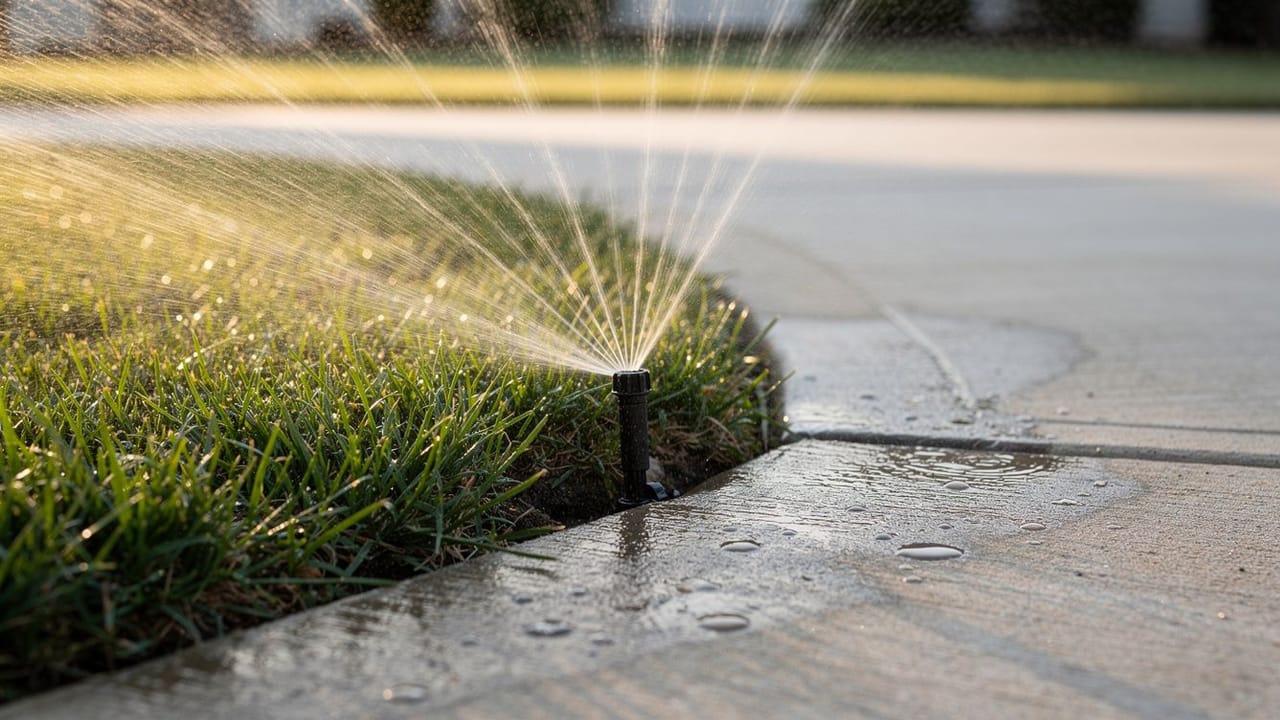
A head that sends up a fine fog instead of distinct streams is running at too much pressure. Strong pressure at the street does it, and a zone with only a few heads on it makes it worse. The EPA’s WaterSense page on spray sprinkler bodies says high system pressure can lead to excessive flow rates, misting, fogging and uneven coverage, and that integral pressure regulation can reduce water waste by providing a constant flow at the nozzle. Mist drifts onto the driveway on a breeze and evaporates before it reaches the roots, so the lawn looks watered at dawn and is dry by lunch.
The fix is a head with a regulator built into the body. Toro’s 570Z PR Series, for example, has a factory regulator that operates at 30 psi to prevent misting. When we find one misting head we check the rest of the zone, because they share the same pressure, and swapping one head out of six leaves five still fogging. On a repair call where every zone mists, a regulated head on each is usually the better answer than chasing nozzles one at a time.
Setting the height, and keeping it there
How a head sits matters as much as which head it is. Toro’s installation instructions for the 570 Series say the pop-up should be installed so the top of the cap is level with the final finished grade. Set it high and the mower clips it; set it low and the turf grows over it. Lawns do not stay where they were graded, either. Sod settles over trenches, clay shifts through a wet winter and a dry summer, and thatch builds up in Bermuda and zoysia, so a head that was level the year the system went in can be an inch low a few years later.
That is why we connect heads with a swing joint or flexible riser instead of screwing them straight onto a rigid fitting on the lateral. The flexible connection lets us lift a sunken head back to grade without cutting pipe, and when a mower or a tire hits a head, it gives instead of snapping the fitting below the ground. On a repair we dig the head out, clean the body, set it level and plumb at finished grade, firm the soil around it and run the zone to check the arc before we move on.
Sources
- U.S. EPA WaterSense, Fix a Leak Week — A 1/32-inch irrigation leak can waste about 6,300 gallons a month
- U.S. EPA WaterSense, Spray Sprinkler Bodies — High pressure causes misting, fogging and uneven coverage; integral pressure regulation reduces waste
- Toro, 570Z PR Series — Factory regulator operates at 30 psi to prevent misting
- Toro, 570Z/570S Installation Instructions — Top of the cap level with the final finished grade
- Rain Bird, How to Know Where to Place Sprinkler Heads — Head-to-head spacing; matched precipitation rate nozzles for fixed spray heads