
· by Michael Blair, Nashville's Irrigation
A sprinkler system watering the lawn in the middle of a downpour looks like a fault, but usually it is the controller doing what it was set to do. A standard controller runs on days and start times, and it has no idea it rained unless something tells it. University of Tennessee Extension’s irrigation guide lists three ways to give it that information. This post covers what each one does, how they differ from a smart controller, why a system that has a rain sensor can still run in the rain, and what we check when it does.
Why do my sprinklers run when it is raining?
Sprinklers run in the rain because the controller follows its programmed schedule unless a device or a setting suspends it. University of Tennessee Extension’s W 871, Basics of Irrigation in the Residential Landscape, describes the ordinary timer program as watering days, a start time and a run time for each zone. The optional features it names for managing water are rain delays, rain gauge shutdown and soil sensor shutdown, and it says that without one of them you should turn the controller off yourself when it rains.
Watering on top of rain is more than wasted water. UF/IFAS Extension’s guide to managing landscape irrigation to avoid soil and nutrient losses says that failing to bypass the schedule during rain can put down more water than the soil can hold, which is how water and nutrients leave the root zone. On clay soil, that extra water can run off. If your water bill jumped with no change in how you use water indoors, our post on why the water bill jumps in summer covers the other causes.
Is a rain delay the same as a rain sensor?
A rain delay is not the same as a rain sensor: a delay is a pause someone sets on the controller, while a sensor reacts to the weather on its own. UT’s W 871 describes the delay as turning the controller off for a chosen period before it resumes its schedule, and gives the example of suspending watering for seven days after an inch of rain. The delay only happens if someone remembers to set it.
A rain gauge shutdown does it automatically. UT describes controllers fitted with rain gauges that suspend watering for longer or shorter periods depending on how much rain fell. A soil moisture sensor goes a step further: it keeps the controller from running until the soil dries to a set moisture level, so UT notes it responds both to rain and to changes in how fast the landscape is using water. The Irrigation Association’s homeowner’s guide to landscape irrigation adds freeze sensors to the list, which shut the system off in freezing weather.
A smart controller is a different tool again. The Irrigation Association describes it as adjusting the schedule itself from weather or soil moisture, and our post on whether smart irrigation controllers are worth it weighs that against a sensor on a standard controller.
Can a rain sensor be added to an existing sprinkler system?
A rain sensor can usually be added to an existing system. UT’s W 871 says most controllers can be retrofitted with a rain gauge or a soil moisture sensor, and the Irrigation Association’s guide says rain, freeze and soil moisture sensors can be wired to any controller. Adding one keeps the controller you have, and it is one of the first things we look for when we work on a sprinkler controller that has none.
Whether you are required to have one depends on where you live. Florida law requires automatic irrigation systems to have a working rain sensor or similar device, as the UF/IFAS guide notes, citing section 373.62 of the Florida Statutes. We found no matching requirement in Tennessee, so here it is a choice rather than a rule. For scale, the EPA’s WaterSense page on weather-based irrigation controllers estimates that more than 28 million U.S. homes have in-ground sprinkler systems.
Why is my sprinkler rain sensor not working?
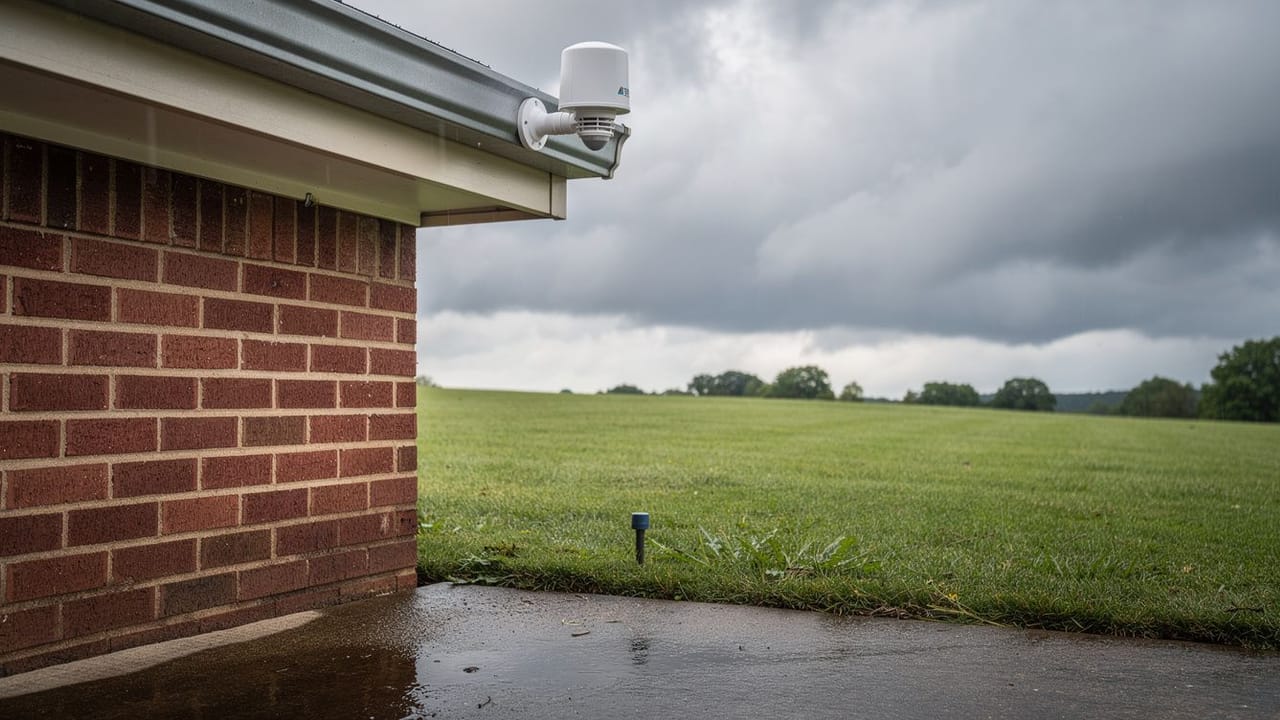
A rain sensor that seems not to work is usually not connected, not being obeyed, or not getting wet, so those are the three things we check first. A sensor only stops watering if it is wired into the controller and the controller is set to respond to it; a bypass left on after a test or a repair means the sensor is ignored. A sensor tucked under an eave or a tree canopy may stay dry through a storm. And the wire between sensor and controller can be cut by digging or landscaping work.
Because maker instructions differ by model, we check a sensor against the sheet for that unit rather than a general rule. UT’s guide ends its discussion of automation with the reminder that it still pays to watch what is happening in the landscape, and that holds here: a zone running during a rainstorm is the sign to look. We repair and add sensors across Nashville and Davidson County and the surrounding towns as part of our sprinkler repair work. If your system runs through the rain, ask us for a free estimate.
Sources
- University of Tennessee Extension, W 871, Basics of Irrigation and Introduction to Systems and Management in the Residential Landscape — Controller options are rain delays, rain gauge shutdown and soil sensor shutdown, and without one the controller should be turned off when it rains; rain delay example of seven days after a 1-inch rain; rain gauges and soil moisture sensors, most controllers can be retrofitted; soil sensors respond to rain and to changing water use; observe the landscape.
- Irrigation Association, The Homeowner’s Guide to Landscape Irrigation (2017) — Rain, freeze and soil moisture sensors can be wired to any controller and turn the system off in rainy or freezing weather or wet soil; smart controllers adjust the schedule from weather or soil moisture.
- UF/IFAS Extension, SL384, Managing Landscape Irrigation to Avoid Soil and Nutrient Losses — Florida law (section 373.62, Florida Statutes) requires a functioning rain sensor or similar bypass device on automatic irrigation systems; not bypassing the schedule during rain can apply more water than the soil holds.
- U.S. EPA WaterSense, Weather-Based Irrigation Controllers — More than 28 million U.S. homes have in-ground sprinkler systems.
FAQ
Sprinkler Rain Sensors and Why Systems Run in Rain — questions
How does a sprinkler rain sensor work?
A rain sensor is wired to the controller and suspends the watering schedule when it registers rain. UT Extension describes rain gauge shutdowns that pause watering for longer or shorter periods depending on how much rain fell, after which the normal schedule resumes. A soil moisture sensor instead waits for the soil itself to dry.
Do I need a rain sensor on my sprinkler system?
We found no Tennessee requirement for one, unlike Florida, where state law requires a working rain sensor or similar device. Without any rain shutoff, UT Extension says you should turn the controller off yourself when it rains. A sensor does that automatically and keeps the system from watering on top of a storm.
Is a rain sensor required for sprinklers in Tennessee?
We found no Tennessee law or rule requiring one. Florida does require it: the University of Florida’s extension guide cites section 373.62 of the Florida Statutes, which calls for a functioning rain sensor or similar device on automatic systems. In Tennessee it is the owner’s choice, and most controllers can take one.
Does a rain sensor work in winter or when it freezes?
A rain sensor responds to rain, not cold. The Irrigation Association lists freeze sensors as a separate device that turns the system off in freezing weather. A system that has been winterized and drained does not need either, since it should not be running at all until spring start-up.