
· by Michael Blair, Nashville's Irrigation
Outdoor watering is the biggest swing in many households’ summer water use. The EPA’s WaterSense page on how we use water puts outdoor use at 30 percent of household use nationally, and higher in more water-intensive landscapes, and its Sprinkler Spruce-Up page says homes with clock-timer irrigation use about 50 percent more water outdoors than homes without it. It’s also where leaks hide. The same EPA page points out that broken heads are hard to find because most systems run overnight or early in the morning, when nobody is watching.
How much of a summer bill increase is normal?
Some of the summer jump is just how Metro Water bills. Its 2026 rate table charges residential water in tiers by the CCF, which is 748 gallons: $4.20 per CCF from 3 to 6, $5.05 from 7 to 10, and $6.31 for every CCF above 10. The extra gallons a busy sprinkler system adds tend to land in that top band.
For the house itself, a winter bill is the better yardstick. The EPA’s Fix a Leak Week guidance suggests looking at use in a cold month like January or February, and says a family of four going over 12,000 gallons a month then could have serious leaks. In summer, what makes us look harder is a jump with no change to the watering schedule, or a bill that stays high through a rainy stretch when the system was barely running.
Finding an irrigation leak
Start at the meter. EPA’s Fix a Leak test is to read it before and after a two-hour stretch with no water in use; if it moves at all, there’s probably a leak somewhere. We run it twice, first with the controller off and the irrigation shutoff open, then with the shutoff closed. A meter that only creeps while the irrigation side is open puts the loss in the sprinkler system rather than the house.
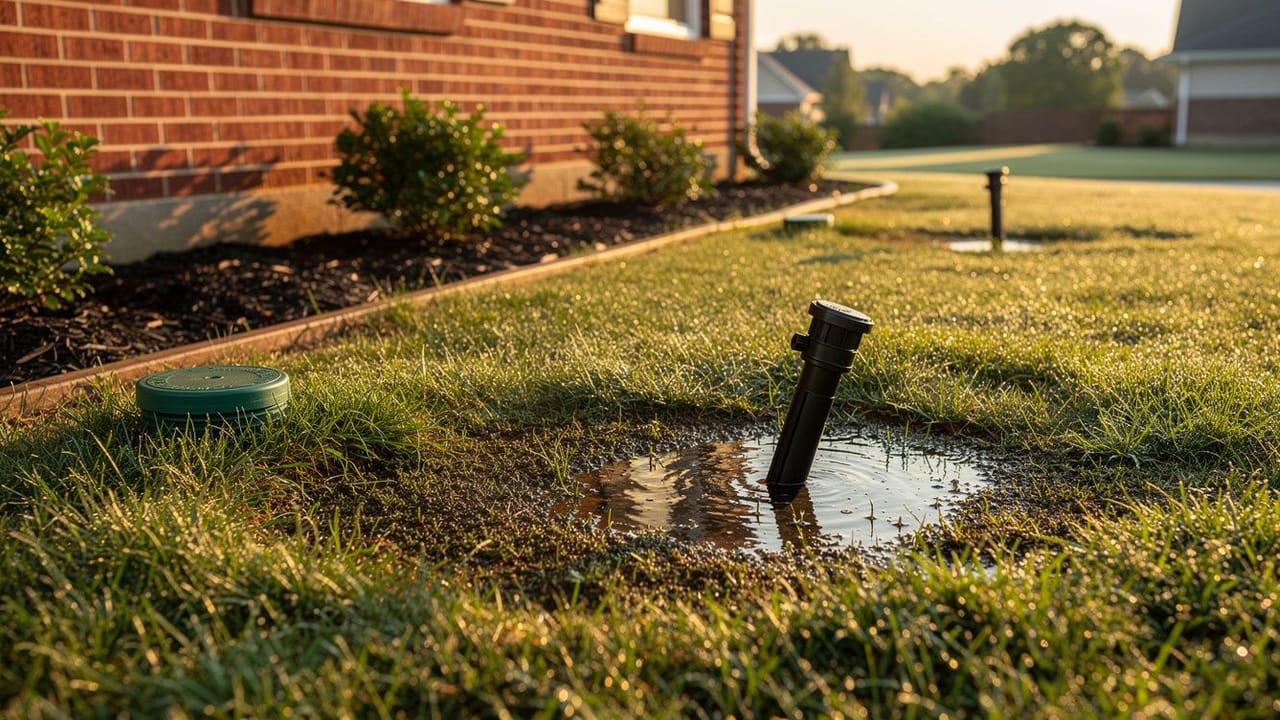
Then run each zone in daylight and walk it, which is what the EPA’s Spruce-Up checklist asks for. Look for heads that don’t pop up fully or sit tilted, and between cycles look for water pooling on the surface, which the EPA says can be a sign of an underground leak. That walk is also where a sprinkler repair visit from our crew starts.
- Read the meter with the irrigation shutoff open, then closed
- Run every zone in daylight and walk it
- Look for ground that stays soft or puddled between cycles
- Check the backflow assembly for a drip
- Open each valve box and make sure every valve shuts
Can a sprinkler valve leak with the system off?
A zone valve that doesn’t close completely can, as the Spruce-Up page puts it, slowly seep water even when the system is turned off. A slow seep may not show at the surface at all, so the bill can be the first thing that gives it away. If you’re on Metro Water in Davidson County and can’t pin it down, Metro’s assistance programs page says a call to 615-862-4600 can get a field representative out to help work out whether there’s a leak.
The pattern we look for is a patch that never dries and a bill that doesn’t answer to schedule changes. For scale, the EPA reckons cracked pipes and broken heads can cost a household up to 25,000 gallons and $280 over a six-month irrigation season. Our post on a sprinkler zone that will not shut off goes through how to stop the water and tell which part has failed.
Reducing the bill legitimately
Set the schedule for the season instead of running one program from April to October. The EPA notes that a system wastes even more when it’s programmed incorrectly, and Metro’s tips for lowering a water bill say to water in the morning or evening so less is lost to evaporation. What a lawn here actually needs is in our post on watering a Nashville lawn, and a weather-aware controller is one way to stop making those changes by hand.
On the sewer side, Metro customers already get much of the relief a separate irrigation meter is usually bought for. The assistance programs page explains that sprinkler water doesn’t go into the sewer, so residential sewer charges on bills from April through November are adjusted automatically, and the most you’re billed for sewer is your January to March average plus 30 percent. If your water comes from a different utility, ask how it bills sewer in summer before paying for a second meter. And if the meter test points at the system, ask us for a free estimate.
Sources
- U.S. EPA WaterSense, How We Use Water — Outdoor use is 30 percent of household use nationally and can be much higher in water-intensive landscapes
- U.S. EPA WaterSense, Sprinkler Spruce-Up — Clock-timer homes use about 50 percent more water outdoors; broken heads hard to find because systems run overnight; walk each zone; heads that do not pop up fully; pooling as a sign of underground leaks; valves that do not close can seep; up to 25,000 gallons and $280 over a six-month season; incorrect programming wastes water
- U.S. EPA WaterSense, Fix a Leak Week — Check winter use (12,000 gallons a month for a family of four); read the meter before and after two hours with no water in use
- Metro Water Services, Rates — 2026 residential water tiers per CCF; 1 CCF is 748 gallons; seasonal sewer adjustment April through November
- Metro Water Services, Assistance and Protection Programs — Seasonal sewer billing and sprinkler adjustment, capped at the January to March average plus 30 percent; field representative for suspected leaks at 615-862-4600
- Metro Water Services, Reduce Water Use and Lower My Bill — Irrigate in the morning or evening to cut evaporation
FAQ
Why Your Water Bill Jumped in Summer — questions
How do I know if my irrigation system is leaking?
Turn the controller off and read the water meter before and after two hours with no water in use, once with the irrigation shutoff open and once with it closed. If the meter only moves while the irrigation side is open, the loss is in the sprinkler system. Then run each zone in daylight and walk it, looking for heads that do not pop up fully and ground that stays wet or puddled between cycles.
Is a separate irrigation meter worth it?
For a Metro Water Services residential account, it may add less than people expect. Metro already adjusts residential sewer charges on bills from April through November, because sprinkler water does not go into the sewer, and caps them at the January to March average plus 30 percent. Metro’s pages on this do not mention a separate irrigation meter, so ask whether one is available and what it would save once that credit is counted. If another utility supplies your water, ask it how sewer is billed in summer.
Why is my bill still high after I reduced watering?
A zone valve that does not close completely can keep seeping water even with the controller off, and a slow leak may not show at the surface at all. A bill that does not respond to schedule changes points at a fault rather than a setting, so run the meter test and walk the zones.
How is a Nashville water bill calculated?
Metro Water charges residential water in tiers by the CCF, which is 748 gallons: on the 2026 table, $4.20 per CCF from 3 to 6, $5.05 from 7 to 10 and $6.31 above 10. From April through November, sewer charges are adjusted automatically and capped at your January to March average plus 30 percent.