
· by Michael Blair, Nashville's Irrigation
Frequent light watering keeps roots near the surface, where the soil dries out first. Clemson Extension’s fact sheet on watering lawns is blunt about it: a small amount every day encourages a shallow root system and leaves the grass less drought tolerant. On fescue lawns across Nashville and Davidson County we set the opposite schedule, the one UT Extension’s turfgrass irrigation fact sheet describes as watering thoroughly and infrequently so the roots grow deep. UT gives the light-and-often school a fair hearing too, since some disease and insect damage may be lower under it, but for a home lawn on an automatic system we go deep and wait. Everything below is about turf; the shrub and flower beds are a separate job, and we explain why we put them on drip irrigation zones of their own in another post.
The number
There isn’t one figure for every yard. EPA WaterSense’s watering tips put a typical landscape’s need at roughly one inch weekly, counting rain, and add that it varies with where you live, the weather and the plants. Fescue in a hot spell can use more: in UT’s worked example, a week with 1.9 inches of pan evaporation leaves tall fescue needing about one and a half inches of rain or irrigation. The same fact sheet says many professionals managing turf on loam soil put down half an inch no more than twice a week, then hold off until the grass shows drought stress. UT’s 2025 lawn maintenance calendar repeats that test month after month, naming rolled leaves and lingering footprints as the signs to water.
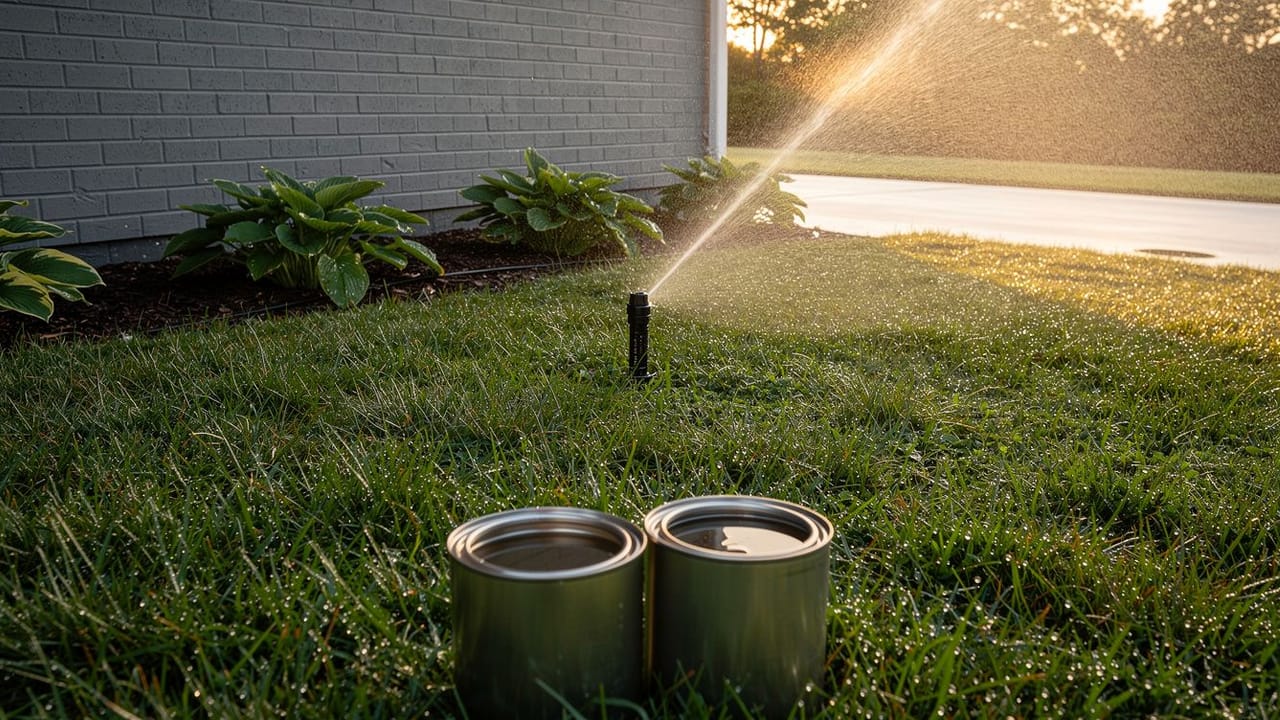
Then measure the zone instead of trusting the minutes on the controller. Clemson’s method uses five to ten coffee cans, tuna cans or other straight-sided containers set out across the area, and WaterSense’s version is to see how many minutes the sprinkler needs to fill the cans to half an inch. Those minutes are your run for one soaking. If the cans fill unevenly, the trouble is spacing or pressure, and our post on dry patches and coverage explains how we read them.
What time of day should sprinklers run?
UT recommends early morning, roughly 5 to 9 a.m., because it cuts evaporation and limits how long the grass stays wet. Evening and night watering leave the blades wet for hours, and UT says night watering should be avoided whenever possible since excessively wet turf is prone to disease. On tall fescue the summer disease to worry about is brown patch, and UT’s lawn calendar has fescue owners treating for it preventively every 28 days through May, June and July.
Midday is the other mistake. UT notes that turf watered in the middle of the day dries fast, but much of the water may evaporate, and WaterSense says the hot sun can take it before it gets to the plants.
- About an inch a week including rain, more in a hot spell
- One or two deep soakings, not daily
- Run the zones roughly between 5 and 9 a.m.
- Measure output with cans rather than estimating
- Cycle and soak on clay to avoid runoff
Cycle and soak on clay
Heavy clay takes water slowly. WaterSense warns that water can easily pool on clay-rich soils or slopes when it goes on too fast, and UT says that on slopes or heavy clay it may be necessary to run each zone several times to avoid runoff. Once water is sheeting off the lawn onto the driveway, whatever the zone puts down after that never reaches the roots.
The answer is several short runs on the same zone, with a pause after each so the water can sink in. Clemson suggests applying about half an inch at a time when runoff stops you putting the whole amount down at once. Where a controller has a cycle-and-soak setting we use it, and where it doesn’t we give the zone two or three shorter start times instead, part of how we program controllers and smart watering on a system.
Is a brown fescue lawn dead or just dormant?
Tall fescue that browns out in a dry July may be dormant rather than dead. Clemson says a well-established fescue lawn can be allowed to go dormant without serious injury, while a newly established one with a limited root system may be severely injured or killed. So the first question about a brown lawn is how old it is.
The second is whether you will keep watering. Clemson warns that once you choose to water you should continue, because coaxing a lawn out of dormancy and then stopping exhausts the plants and can injure them. We ask owners to pick one course for the summer and hold to it: water on signs of stress all the way through, or let an established lawn rest until the weather breaks. If the system is still running a full schedule over brown grass, or you can’t tell which way your lawn has gone, book a free estimate with us.
Sources
- UT Extension, W161-F Turfgrass Maintenance: Irrigation — Deep, infrequent and light, frequent philosophies; tall fescue example of about 1.5 inches a week; half an inch no more than twice a week on loam; avoid night watering; 5 to 9 a.m.; midday evaporation; repeat cycles on slopes and heavy clay
- UT Extension, PB 1903 2025 Lawn Maintenance Calendar — Irrigate only on drought stress, rolled leaves and lingering footprints; preventive brown patch treatment on tall fescue every 28 days, May through July
- Clemson Cooperative Extension, HGIC 1207 Watering Lawns — Daily light watering gives shallow roots; straight-sided cans to calibrate; half an inch at a time where runoff occurs; established fescue can go dormant; once you water, continue
- U.S. EPA WaterSense, Watering Tips — About an inch a week including rainfall; avoid midday evaporation; time cans to half an inch; pooling on clay and slopes; cycle and soak with short breaks
FAQ
How Much to Water a Nashville Lawn — questions
How long should I run my sprinklers?
Long enough to put down about half an inch per soaking, which UT Extension notes many turf professionals apply no more than twice a week on loam soil. The minutes depend on head type and pressure, so measure: set straight-sided cans across the zone, run it, and note the minutes it takes to reach half an inch. A run time copied from a neighbor or a manual says nothing about your own zone.
Is it bad to water at night?
Yes, wherever you can avoid it. UT Extension says night watering should be avoided whenever possible because excessively wet turf is prone to disease, and on tall fescue the summer disease UT’s lawn calendar guards against is brown patch. Its suggested window is early morning, roughly 5 to 9 a.m., which limits evaporation and lets the blades dry as the day warms.
Should I water a dormant lawn?
Decide once and stick with it. Clemson Extension says an established fescue lawn can go dormant in summer without serious damage, but waking it with water and then stopping can exhaust the plants and injure them. A new lawn with a short root system is different, because dormancy can kill it. If you do water, water when the grass shows stress, such as rolled leaves and footprints that linger.
Should I water my lawn every day?
No. Clemson Extension says a little water every day builds a shallow root system and leaves the grass less able to handle drought. We set one or two deep soakings a week instead and hold off until the grass shows stress, such as rolled leaves or footprints that stay pressed into the turf.