
· by Michael Blair, Nashville's Irrigation
A dry patch in an irrigated lawn is often telling you about distribution rather than duration. The EPA’s WaterSense Sprinkler Spruce-Up page asks homeowners to aim heads for uniform coverage so the landscape does not get dry spots, and that is where we start. Running the zone longer to reach the one short spot puts extra water on everything else, and WaterSense’s watering tips count weed growth, disease, fungus and stormwater runoff among the results of overwatering.
How far should each sprinkler head throw?
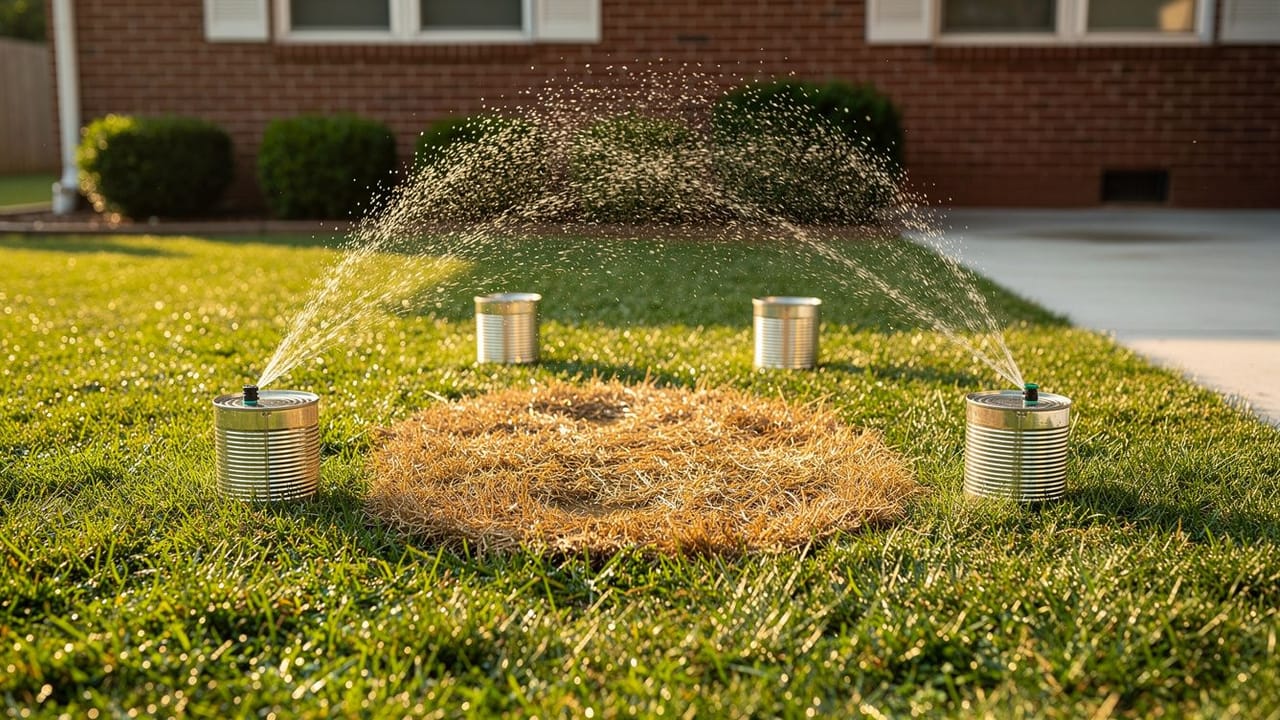
Each head in a layout should throw far enough to reach the next one, which WaterSense calls head-to-head coverage. Where a throw falls short of its neighbor, the strip halfway between the two gets the least water, and that strip is where a dry band can show.
We do not try to fix spacing from the controller, because extra minutes raise the whole zone and the gap between the wet and dry parts stays where it was. When heads were set too far apart, the answer is in the layout itself: adding or relocating heads, or changing nozzles. That is design work, and it is how we lay out new sprinkler systems from the start.
The catch-can test
To see the pattern, set containers of the same shape and size across the zone, run it for a set time, then compare the depths. UF/IFAS Extension’s guide to operating residential irrigation timers calls for at least six cans per zone, placed at least a foot from the heads, with each zone measured separately. WaterSense does a homeowner version of it with empty tuna cans, and also uses them to set run time by timing how long the cans take to reach half an inch, which our post on how much to water a Nashville lawn goes into.
For coverage, what we read from the cans is how evenly they filled. Wide variation points at distribution, and the causes we check are spacing, pressure, mixed head types and anything blocking a nozzle. WaterSense names obstructions that keep heads from distributing water evenly, and the UF/IFAS guide lists pressure problems among the reasons a zone puts down a different amount than its numbers say it should.
- Each head should reach the next head, not stop at the midpoint
- Rotors and spray heads put water down at different rates
- Check for blocked nozzles and heads that will not retract
- Trim back grass that has grown up around a head
- Pressure that is too high turns the spray into mist
Why can’t rotors and spray heads share a run time?
Rotors and fixed spray heads apply water at different rates. The UF/IFAS guide gives typical ranges of 0.25 to 1.0 inch an hour for rotors, 0.75 to 2.0 inches for fixed sprays and 0.4 to 0.6 inch for rotary-nozzle heads. The ranges overlap, and the guide says each zone has to be measured on its own, but on a zone that mixes the two kinds, a run time long enough for the rotors can leave the spray areas soaked.
A controller gives a zone one run time, and a single run time cannot suit both kinds of head. We put them on separate zones where the system allows it, or match the heads to the zone, the same rule we follow when replacing a broken one in our post on sprinkler head repair.
Pressure
High pressure is the easier one to name. WaterSense’s product guidance for spray sprinkler bodies links it to excessive flow, misting, fogging and uneven coverage, and some sprinkler bodies on that page control pressure at the inlet to the nozzle. The Spruce-Up page adds that leaking joints can be a sign of too much pressure or of particles in the water.
Low pressure we confirm with a gauge on site before touching the layout, since a weak zone and a badly spaced one can leave the same brown arc. Neither problem is solved at the controller. If a zone mists, or your cans come back uneven, book a free estimate and we will walk the zone with you.
Sources
- U.S. EPA WaterSense, Sprinkler Spruce-Up — Uniform coverage to avoid dry spots; head-to-head coverage; obstructions that prevent even distribution; leaking joints and too much pressure
- U.S. EPA WaterSense, Watering Tips — Overwatering leads to weed growth, disease, fungus and runoff; tuna-can test and timing cans to half an inch
- University of Florida IFAS Extension, Operation of Residential Irrigation Timers (CIR1421/AE220) — Catch-can method: six or more same-shape cans, a foot from heads, each zone measured separately; application rates by head type; pressure problems
- U.S. EPA WaterSense, Spray Sprinkler Bodies — High pressure causes excessive flow, misting, fogging and uneven coverage; pressure control at the nozzle inlet; up to 50 percent of outdoor water wasted by overwatering
FAQ
Dry Patches and What They Say About Coverage — questions
Why does my lawn have dry spots even though the sprinklers run?
Often it is distribution rather than duration: heads spaced too far apart, a blocked nozzle, grass grown up around a head, or rotors and sprays sharing one zone. Running longer to reach the dry patch overwaters everything else. The EPA’s WaterSense program lists disease, fungus, weed growth and runoff among the results of overwatering, and its spray sprinkler body page cites expert estimates that as much as half of outdoor water use is wasted to overwatering.
Can I mix rotor and spray heads on one zone?
We would not. They apply water at different rates, so a run time that suits the rotors can flood the spray-head areas and one that suits the sprays can leave the rotor areas dry. A zone gets one run time from the controller, so the fix is separate zones or matched heads rather than a new program.
How do I test my sprinkler coverage?
Set at least six containers of the same shape and size across the zone, at least a foot from the heads, run it for a set time and compare the depths. For coverage, look at how evenly they filled. The same cans can help set run time, since WaterSense suggests timing how long they take to collect half an inch. Wide variation between cans points at spacing, pressure or a blocked nozzle, and it tells you where to look.
How long does it take a sprinkler to put down 1 inch of water?
It depends on the heads, so time your own zone. UF/IFAS Extension gives typical rates of 0.25 to 1.0 inch an hour for rotors, 0.75 to 2.0 for fixed sprays and 0.4 to 0.6 for rotary nozzles. Set out tuna cans, time how long they take to reach half an inch, and double it.