
· by Michael Blair, Nashville's Irrigation
Beds and lawns want different things. A lawn needs even coverage across the whole area; a bed needs water at the roots of particular plants. Utah State University Extension’s guide to backyard drip irrigation notes that pop-up heads in a flower bed are usually laid out head to head, the way a lawn is, so they also water the ground where nothing is planted, and it calls that wasteful.
Why is drip better than spray heads in a bed?
Drip sends the water into the soil at the plant and leaves the foliage dry, which University of Maryland Extension’s page on drip irrigation credits with preventing disease problems. The Utah State guide names powdery mildew among the leaf diseases that spray in a bed makes more likely. Spray has another problem once a bed fills in: the bigger shrubs block the pattern and leave the plants behind them in what Utah State calls a rain shadow.
Less of the water goes to waste, too. Maryland says 90 to 95 percent of drip water goes into the soil, and Utah State puts a well-designed system at up to 90 percent efficient, with little lost to evaporation, runoff or leaching. The bare ground between plants stays dry, so fewer weeds start there; UF/IFAS Extension’s drip-irrigation publication makes the same point about the dry rows between crops.
Converting an existing zone
A spray zone serving a bed can usually be converted. Utah State describes the kits made for it: a body shaped like a sprinkler canister that feeds drip tubing where the spray head used to sit, often with a pressure-reducing mechanism inside. The guide does not say the kits include a filter, and some drip valves have one built in, so we check the valve and add an inline filter where there is none. Utah State calls for 120 to 200 mesh on most drip systems.
Drip runs at much lower pressure than spray. Utah State puts most home systems between 40 and 100 psi and most drip between 10 and 30, so the pressure has to come down for drip to work as designed, and the emitters should run at the pressure their maker rates them for. The UF/IFAS publication says a drip system should never run without a filter and lists leaving out the filter or the pressure reducer among common setup mistakes. When we lay out a new sprinkler system, the beds get drip zones of their own and the lawn keeps its heads.
- A pressure regulator and a filter on every drip zone
- Convert bed zones, keep lawn zones on rotors
- Emitters at each plant in an open bed, evenly spaced in a dense one
- Run drip zones much longer than spray zones
- Flush the line ends and clean the filter on a schedule
How long should a drip zone run?
Drip applies water slowly, so a drip zone runs far longer than the spray zone it replaced. For a vegetable garden on drip tape, Maryland Extension says thoroughly wetting the root zone can take as little as two to three hours or as long as 24, depending on soil type, temperature, crop and how the tape is spaced. A shrub bed on point emitters will have its own number, set by the emitter flow and the soil, and the lawn zones are a separate question, covered in how much to water a Nashville lawn.
A converted zone left on its old spray schedule will underwater the bed. The opposite mistake is just as easy, and it is the one Utah State calls common: overwatering, even with drip. Its advice is to let the soil dry down before the next run, since soil that stays wet raises the risk of disease and root rot. Setting the new run time on the zone’s controller is part of every conversion we do.
Maintenance
Emitters clog over time from sediment, mineral scale and slime. Metro Water Services’ 2025 water quality report gives Nashville’s calcium hardness as an average of 75.3 milligrams per liter, which falls in the moderately hard band on the UF/IFAS scale, and Utah State says city water is typically fine to run through drip. A well or another utility will have its own numbers. The filter is what keeps sediment out of the emitters, and Utah State says to inspect and clean it monthly through the growing season, or weekly where the water carries a lot of sediment.
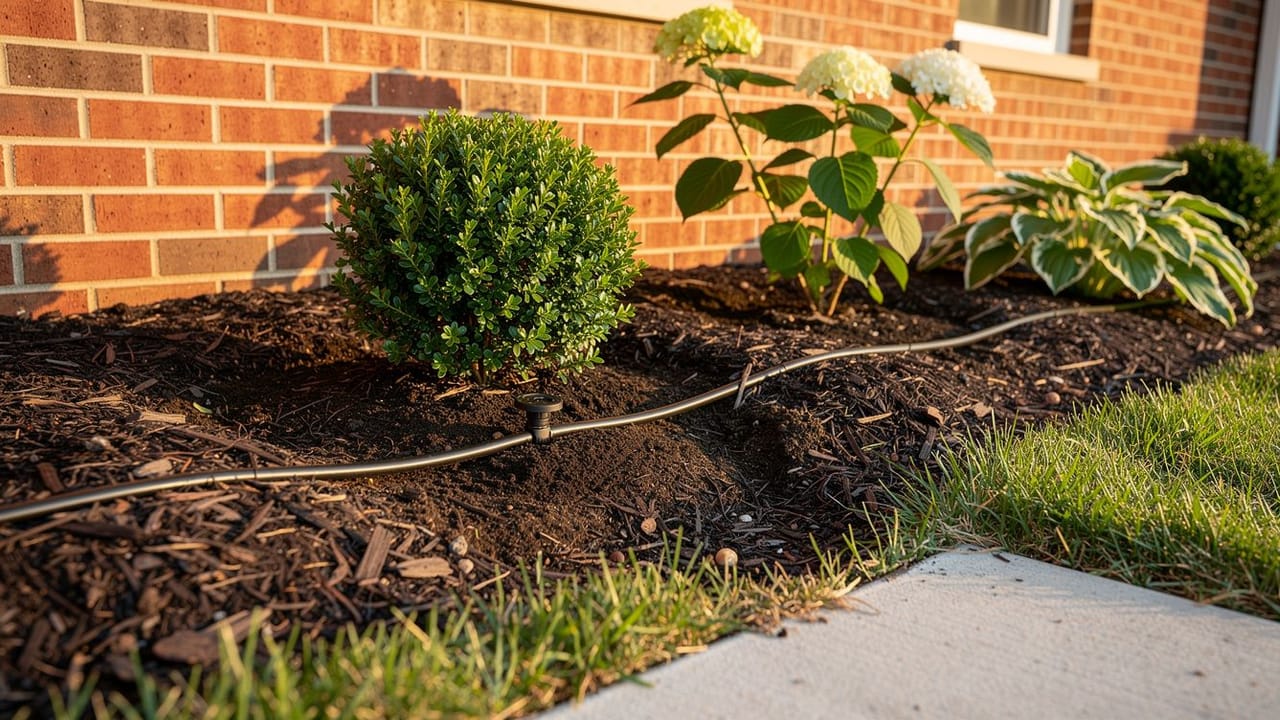
Flushing clears the precipitates and slime that collect inside the line, according to UF/IFAS. Self-flushing end caps do it on every cycle; capped or tied ends have to be opened by hand, and where we find them we run the zone with the ends open until the water comes out clean. Lay the tubing on the soil and mulch over it. Maryland suggests mulch over drip tape left on top of the ground, UF/IFAS warns that uncovered tape can be lifted by wind or moved by animals, and the EPA’s WaterSense landscaping tips put mulch at three to four inches for most plants. On the surface, the emitters stay where you can find and check them.
A bed also changes as it grows. Utah State says it is very common for trees and shrubs to die three to four years after planting because nobody added emitters as they got bigger, so the emitter count and placement need revisiting, with emitters moved out toward the edge of the canopy. If your beds are still on spray heads, ask us for a free estimate on converting the zone.
Sources
- Utah State University Extension, The Do-It-Yourself Guide to Backyard Drip Irrigation (2025) — Spray in beds is wasteful and raises powdery mildew risk; rain shadow; up to 90 percent efficient; conversion kits with pressure reducers; 40 to 100 psi vs 10 to 30 psi; 120 to 200 mesh, cleaned monthly; overwatering is a common mistake; city water typically fine; add emitters as plants grow
- University of Maryland Extension, Drip Irrigation — Dry foliage prevents disease; 90 to 95 percent into the soil; 2 to 3 up to 24 hours to wet the root zone; mulch over drip tape left on top
- UF/IFAS Extension, Drip-Irrigation Systems for Small Conventional Vegetable Farms and Organic Vegetable Farms (HS388, 2018) — Dry row middles reduce weeds; never run without a filter; missing filter or pressure reducer as setup mistakes; flushing clears precipitates and slime; mulch keeps tape from wind and animals; hardness scale
- Metro Nashville Water Services, 2025 Water Quality Report — Calcium hardness averaged 75.3 mg/L in 2025
- U.S. EPA WaterSense, Landscaping Tips — Mulch three to four inches deep; mulch reduces evaporation
FAQ
Drip Irrigation for Nashville Planting Beds — questions
Can I convert a spray zone to drip?
Usually yes. Conversion kits replace the spray head with a body that feeds drip tubing, and many have a pressure reducer built in. Add a filter if the zone valve does not already have one. The bigger change is the schedule: drip puts water down far more slowly, so the zone needs a much longer run time than it had as spray, and the soil should still dry down between runs.
Does drip irrigation clog?
Emitters can clog over time from sediment, mineral scale and slime in the line. A filter of 120 to 200 mesh catches the sediment and should be cleaned about monthly in the growing season, and flushing the line ends clears what builds up inside. Metro Nashville’s water measured moderately hard in 2025, and city water is generally considered fine for drip, but wells and other utilities vary.
Should drip tubing go under mulch?
Yes. Lay it on the soil surface and cover it with mulch rather than burying it. The mulch keeps the tubing from being lifted by wind or moved by animals, hides it and cuts evaporation from the soil, and leaving it on the surface means the emitters can still be reached for checking. Three to four inches of mulch suits most plants.
How often should drip irrigation run?
Only once the soil has dried down from the last run, which is Utah State Extension’s advice. It calls overwatering a common mistake even with drip, because soil that stays wet raises the risk of disease and root rot. Each run is long, though, since drip applies water slowly, and its length depends on emitter flow and soil.