
· by Michael Blair, Nashville's Irrigation
Late fall is digging season in Middle Tennessee. Trees and shrubs go in, fence posts get set, beds get edged, and somewhere in the middle of it a shovel lands on a white or black pipe a few inches under the sod. A cut line on a zone that has already been shut down for the year can go unnoticed until the system starts again in spring. Here is how deep sprinkler pipe usually sits, why the 811 locators will not find it for you, and how to find it before you dig.
How deep are sprinkler lines usually buried?
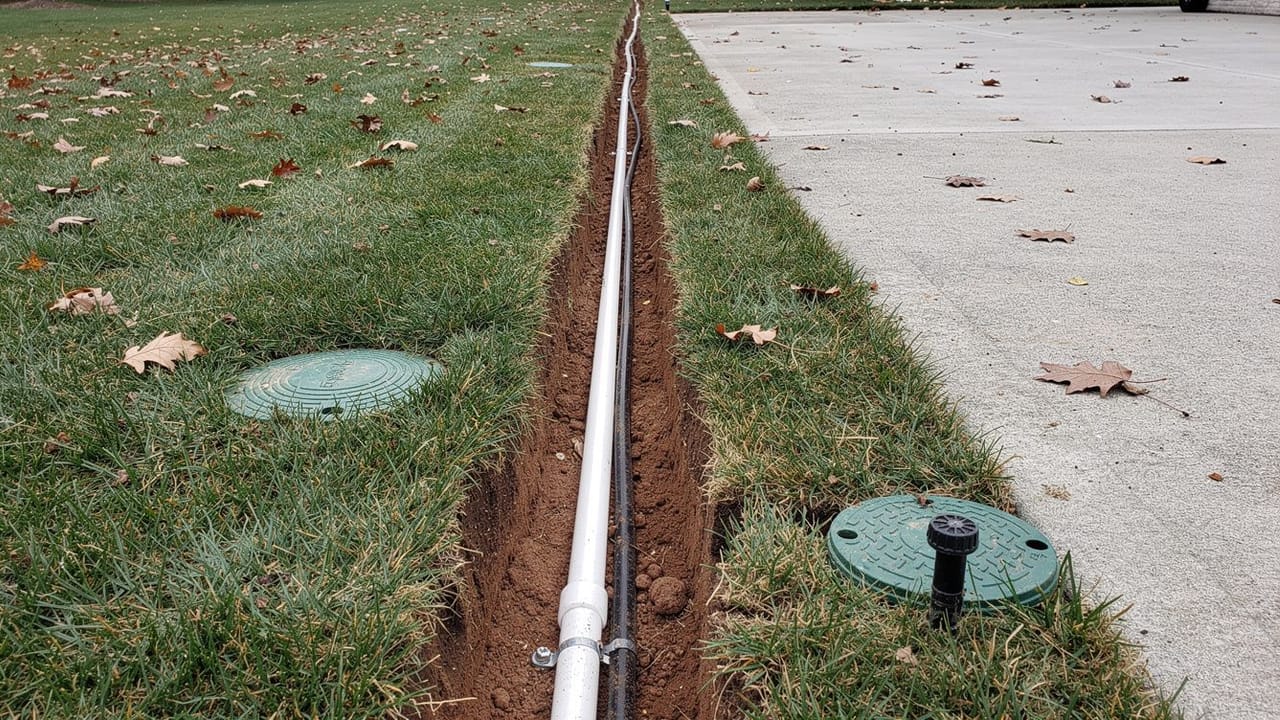
Most residential sprinkler pipe sits between 6 and 12 inches down. That is the range Rain Bird’s sprinkler system installation guide gives for typical trenches, and the University of California’s guide to installing a turf irrigation system calls for trenches about 8 to 10 inches deep and 4 inches wide. Both are installation guidance rather than a Tennessee code minimum, and the system in your yard may not match either, since the depth depends on whoever dug the trench.
Not every line went in by trench. Rain Bird notes that flexible poly pipe can be buried with a pipe-pulling machine, which puts it in the ground without digging up the lawn, and says poly is less likely to be damaged by freezing. It also says it does not recommend poly for the main line, the pipe that carries water from the supply to the valves. So one yard can hold PVC main line in a trench, poly laterals pulled in, and control wire running out to the valves, not necessarily all at the same depth.
Why won’t 811 mark my sprinkler lines?
Because a sprinkler system is a private facility, and utility locators mark only lines their own companies operate. Tennessee 811’s homeowner page says the utilities’ own locators will not find or flag privately owned buried lines, counts irrigation lines among those, and leaves the job of having them located to the property owner. It keeps a list of private locating services working in Tennessee for that.
The call is still required. Tennessee 811 asks for at least three working days’ notice before digging, and up to ten if your schedule allows, so the gas, power, water and communication lines get marked. Purple is the color on its marking chart for reclaimed water, irrigation and slurry lines, but paint comes from whoever operates a line, and none of the utilities operate yours. Your own sprinkler pipe stays unmarked unless you, a private locator or your irrigation company finds it.
Does burying sprinkler pipe keep it from freezing?
Not on its own. Pipe 6 to 12 inches down still holds water after the last cycle of the year, and the backflow preventer at the start of the system stands above ground. Rain Bird’s homeowner sprinkler installation guide says designs for freeze-prone regions should include a blow-out port downstream of the backflow assembly, which is the fitting used to push the water out of the pipe with compressed air.
That port is what a fall blow-out uses. Our post on winterizing an irrigation system in Tennessee goes through the steps, and our winterization service schedules blow-outs ahead of the first hard freeze. Depth keeps a pipe away from a mower blade and a rake. It does not empty the pipe, and it does not protect the parts of the system that sit at or above the surface.
Finding the lines before you dig
Sprinkler pipe runs from the valves out to each zone and from head to head, so the system you can see draws a rough map of the system you cannot. We start at the controller and the valve boxes, which show where each zone leaves the manifold, then follow each zone’s heads in their rows, running one zone at a time to see which heads belong together. Rain Bird’s guide lays pipe along a string line between head locations, and the UC guide sets heads at least 2 inches in from a sidewalk or driveway, so straight runs between heads and along paved edges are where to expect pipe.
Where a fence line, a new tree or a new sprinkler system has to cross existing pipe, we expose it by hand before any machine digging starts. If a shovel has already found a line, our sprinkler repair crews fix cut pipe and wire and then run every zone to check the rest. Whether the yard is in Belle Meade or anywhere else in Davidson County, ask us for an estimate before the digging starts, or after it goes wrong.
Sources
- Rain Bird, Sprinkler System Installation Guide — Typical trench depths of 6 to 12 inches; pipe-pulling machine for poly pipe; poly less likely to be damaged by freezing; poly not recommended for the main line
- Rain Bird, Homeowner Sprinkler Installation Guide (PDF) — Freeze-prone regions: blow-out port downstream of the backflow assembly
- Tennessee 811, Homeowners — Operators may not mark private facilities, including irrigation lines; owner responsible; three to ten working days’ notice; purple for reclaimed water, irrigation and slurry lines
- University of California IPM, Healthy Lawns: Installing a Turf Irrigation System — Trenches about 8 to 10 inches deep and 4 inches wide; heads at least 2 inches in from sidewalk or driveway edges
FAQ
How Deep Are Sprinkler Lines Buried? Before You Dig — questions
What color paint marks irrigation lines?
Purple. Tennessee 811’s marking chart assigns purple to reclaimed water, irrigation and slurry lines. A homeowner’s own sprinkler system is a private facility, though, and Tennessee 811 says utility locators may not mark private lines, so your system will not be painted unless you hire a private locator or an irrigation company to find the pipe.
Who locates private sprinkler lines in Tennessee?
The property owner is responsible. Tennessee 811 says utility locators will not mark private buried lines, irrigation lines among them, and keeps a list of private locating services operating in the state. An irrigation company can also trace a system from its controller, valve boxes and heads, running one zone at a time to see which heads belong together.
Can poly pipe be used for a sprinkler main line?
Rain Bird advises against it. Its installation guide says it does not recommend poly pipe for the main line, which carries water from the supply to the zone valves. Poly is common for the lateral lines that feed the heads, where Rain Bird notes it is flexible and less likely to be damaged by freezing.
Can sprinkler pipe be installed without trenching?
Poly pipe can. Rain Bird’s installation guide says a pipe-pulling machine, available from tool rental suppliers, buries poly pipe without digging up the lawn. Rigid pipe still goes in a trench, which Rain Bird puts at a typical 6 to 12 inches deep, and since it does not recommend poly for the main line, that run is usually trenched.