
· by Michael Blair, Nashville's Irrigation
On a summer morning in Brentwood it is easy to spot the houses whose driveways are wet before the sun is up. That water came from the irrigation system, and none of it is doing the lawn any good. It is one of the most common things we find on a sprinkler repair visit, and it is usually not one big failure but several small ones: a nozzle that turned when a mower clipped it, an arc opened wider than the bed, a rotor throwing past the edge of the turf. Here is why heads drift off target, how they are put back, and how to fix the driveway without starving the grass beside it.
Why do sprinklers spray the driveway?
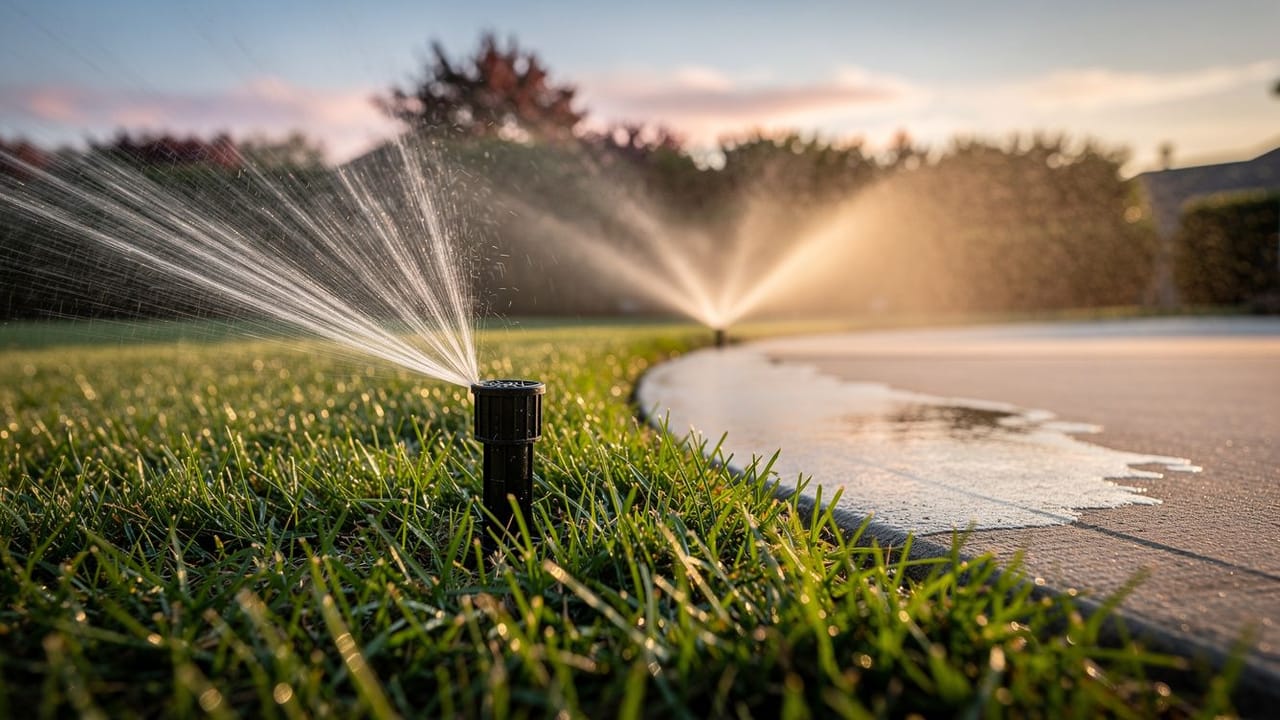
Because a head is aimed, set or pressurized for a different spot than the one it now waters. The usual causes are a nozzle that has rotated on its riser, an adjustable arc set wider than the lawn it serves, a spray or rotor throwing farther than the distance to the pavement, a head knocked out of plumb so the whole pattern tilts, or pressure high enough to break the spray into mist that drifts on a breeze. Our post on sprinkler head repair covers the heads that lean, sink or stick, which often start the problem.
It matters for more than a stained driveway. EPA WaterSense’s Sprinkler Spruce-Up page says sprinkler water landing on pavement and other hardscape ends up in the stormwater drain rather than the yard, and it notes that a home whose irrigation runs on a clock timer uses about 50 percent more water outdoors than a home with no system, with more wasted when a head is pointed in the wrong direction. A head that soaks the driveway is paid for on the water bill and returns nothing.
How do you stop sprinklers from hitting the driveway?
Turn each offending head back toward the lawn, then narrow its arc and shorten its throw only as much as the edge needs. WaterSense says sprinklers spraying onto driveways, sidewalks or walls should be turned toward the landscape and adjusted as wide or as narrow as necessary. On a spray head that means rotating the nozzle and setting its arc to match the corner or edge it sits on; on a rotor, setting the arc stops and the radius so the stream ends at the turf line.
The catch is coverage. The same WaterSense page asks that each sprinkler reach the next head, which is called head-to-head coverage, so the lawn is watered evenly. Crank a radius screw down hard to keep water off the concrete and the head may no longer reach its neighbor, and a few weeks later there is a brown band along the driveway that looks like a different problem. Our post on sprinkler coverage problems explains that pattern. When an edge head cannot be both on target and reaching its neighbor, the answer is usually a different nozzle or a moved head, not a tighter setting.
Can high water pressure cause overspray?
Yes. WaterSense lists overspraying or misting from high pressure among the things to avoid, and points out that leaking joints between the sprinklers and the pipe can also be a sign of too much pressure. Its advice is to check that the pressure regulator is installed properly and to consider spray sprinkler bodies with pressure regulation built in, which hold a steady pressure at the nozzle. Fine mist off a high-pressure head lands wherever the wind carries it, so a driveway can be wet from a head that is aimed correctly.
Checking a whole zone, and watering when Metro asks
One wet driveway usually means the rest of the zone deserves a look. The University of Minnesota Extension’s guide to auditing home lawn irrigation systems, written for Minnesota lawns but sound anywhere, starts by running each zone and looking for broken sprinklers, low pressure and water spraying where it is not needed, such as on streets. It then measures how evenly the zone waters with catch cans, and says a system scoring below 60 percent uniformity should be adjusted. That is the order we follow: watch every head run, fix what is broken or off target, then check the evenness of what is left.
Water on the pavement also counts against the system when demand is high. In an August 2024 notice, Metro Water Services asked Davidson County customers with automatic systems to water on a schedule by address, odd numbers Monday, Wednesday and Friday and even numbers Tuesday, Thursday and Saturday, no more than three days a week and between 7 p.m. and 4 a.m. Those requests can change, so check Metro Water’s current notices, but every gallon kept off the driveway is a gallon that counts toward the lawn on the days you are allowed.
We tune systems in Brentwood and across Williamson County and Middle Tennessee. If your sprinklers are watering the driveway, the walk or the side of the house, ask us for a repair visit and we will run every zone with you and set each head before we leave.
Sources
- US EPA WaterSense, Sprinkler Spruce-Up — Turn heads spraying driveways, sidewalks or walls toward the landscape; hardscape water goes to the stormwater drain; head-to-head coverage; avoid overspray and misting from high pressure; leaking joints and pressure regulators; clock-timer homes use about 50 percent more water outdoors
- University of Minnesota Extension, Auditing home lawn irrigation systems — Run each zone and look for broken heads, low pressure and water where it is not needed such as streets; catch-can test; adjust systems below 60 percent uniformity (Minnesota guidance)
- Metro Water Services, Irrigation placing heavy demand on water system (August 28, 2024) — Voluntary odd and even address schedule for automatic systems, three days a week or fewer, 7 p.m. to 4 a.m.
FAQ
Why Sprinkler Heads Water the Driveway — questions
Where does sprinkler water on the driveway go?
Down the pavement to the street and into the storm drain. EPA WaterSense says water landing on hardscape ends up in the stormwater drain rather than the yard, so none of it reaches the roots. It still runs through the meter, which means it is paid for on the water bill and returns nothing to the lawn.
Why is my sprinkler watering the sidewalk?
Usually because the nozzle has rotated, the arc is set wider than the lawn, the spray throws past the turf edge or the head is tilted. High pressure can also turn the spray to mist that drifts onto the walk. Run the zone, watch which head is responsible, and correct its aim, arc or throw.
How do you know if sprinkler pressure is too high?
Signs include heads that mist or fog instead of throwing clean streams and joints that leak between the sprinkler and the pipe, both of which EPA WaterSense ties to excess pressure. Check that the pressure regulator is installed properly, and consider spray bodies with built-in pressure regulation on zones that mist.
How do you adjust sprinkler head direction?
On most spray heads the nozzle turns on its riser to point the pattern, and adjustable nozzles let you open or close the arc. Rotors have their own arc and radius settings. Turn the pattern toward the lawn, run the zone, and confirm each head still reaches the next one so the edge does not dry out.