
· by Michael Blair, Nashville's Irrigation
An irrigation system is a network of pipes lying in the soil, connected to the same supply that feeds the kitchen tap. Tennessee’s Division of Water Supply recognizes every lawn irrigation system, residential ones included, as an actual and potential cross-connection to the public water system, according to TDEC’s Cross-Connection Control Manual. What keeps the two apart is one mechanical assembly, and the only way to know it still holds is to put gauges on it. That test is the subject of our backflow testing page; this is why it exists.
What backflow actually is
Water in a supply line normally moves one way because the main is pressurized. The state manual describes two ways that reverses. Backsiphonage comes from lowered pressure in the main, caused by a line break, main flushing or a heavy draw such as fire fighting. Backpressure is the other: pressure in the private piping climbs above the supply and pushes water back toward it.
Irrigation water is the worst kind to have moving the wrong way. The TDEC manual says contact between sprinkler heads and the soil, or heads sitting submerged, connects the drinking water to water of unknown or unsafe quality, and that many lawn systems have chemicals injected into the piping to fertilize and kill weeds. A head sitting in a puddle after a lawn treatment is that connection in its plainest form. Metro Water Services’ guidelines to winterize irrigation systems describe the backflow device as what protects the home from contamination that starts in the irrigation system.
Why it needs testing rather than inspecting
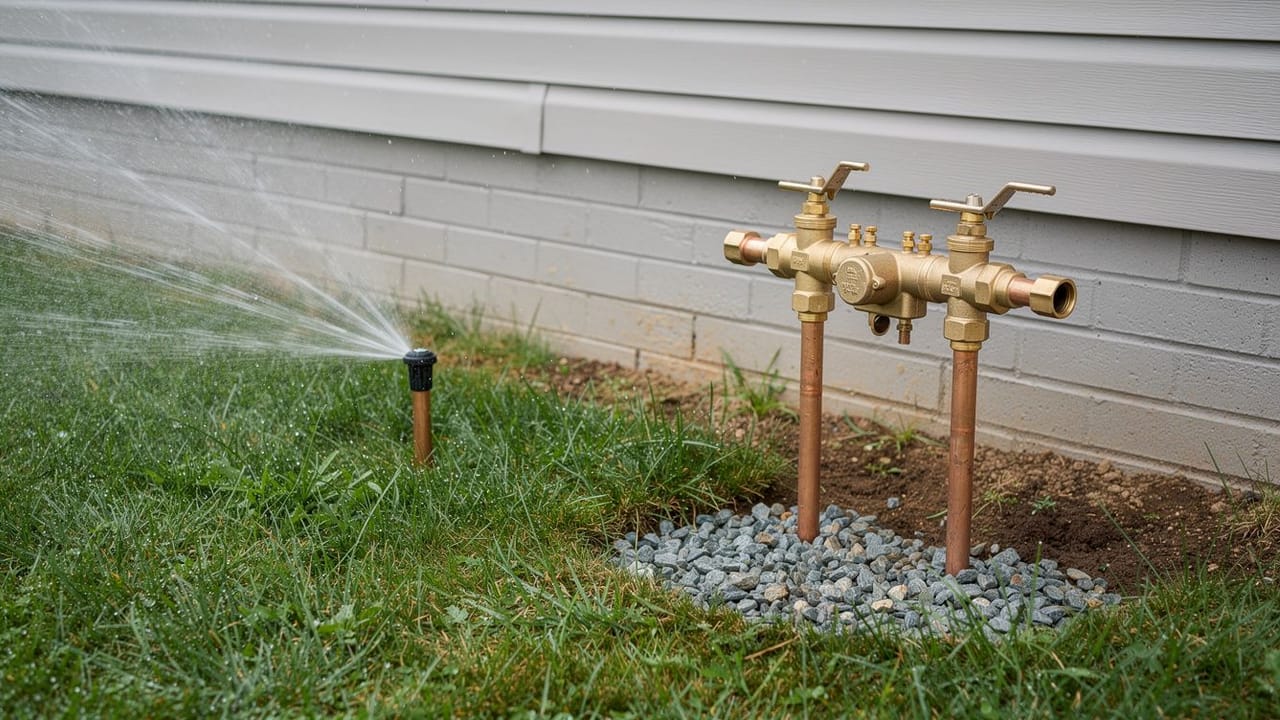
On a lawn system fed by a public water utility, Tennessee’s guidance calls for a reduced pressure principle assembly. A double check valve cannot be used, and vacuum breakers are point-of-use devices that may not stand in for it. Metro Water Services’ variance requirements for backflow installation list the same reduced pressure type for irrigation and require a backflow device on every irrigation system. Inside it are two check valves, with a relief valve between them that opens to the air if the second check lets water leak back.
Those parts wear. The TDEC manual says every mechanical backflow device is subject to fouling, wear and deterioration that can leave it ineffective, and it names debris lodged under a check valve as one of the most common causes of trouble. The EPA’s Cross-Connection Control Manual explains why the relief valve is there at all: any valve may leak from wear or obstruction, so the check valves on their own are not considered enough protection. Looking at the assembly confirms it is installed and tells you little else.
A test settles it with a gauge kit. The state test procedure checks that the relief valve opens at a differential of 2 psid or more and that the second check valve holds tight against backpressure. The person running it holds a Certificate of Competency from the Division of Water Supply, and the gauges are certified every year by a lab the kit maker approves.
- Fouling and wear can leave an assembly ineffective, and a gauge test is how that is found
- Tennessee guidance calls for an annual test, and Metro Water Services inspects every device each year
- Testers hold a state Certificate of Competency and use gauges certified annually
- A reduced pressure assembly is never installed below ground, and its relief port sits at least 12 inches plus the size of the discharge opening above the ground or flood level
- The relief port is never plugged, and the assembly needs protecting from freezing
Why is a backflow preventer at risk in a freeze?
Because the assembly has to stand above ground, it spends the winter exposed, and it holds water. The TDEC manual tells installers to protect it from freezing, and to keep any insulation clear of the relief valve discharge, the test cocks and the name plate. The same manual mentions hose bibb vacuum breakers destroyed in a hard freeze because nobody drained them. The irrigation assembly faces the same nights with more water inside it, and when one has frozen we usually find out at the spring start-up.
For Davidson County, the Metro winterizing sheet lays out the order. Where the irrigation has a meter of its own, Metro prefers the device come off the line for the winter, and drained if it stays. On a combined meter, its #1 and #2 shut-off valves are closed and it is drained. Compressed air for the blowout goes in at a service port behind the device and travels toward the irrigation system only, because blowing air through the device may damage it, and Metro says the ports on the device are for testing only. Our post on winterizing an irrigation system in Tennessee covers the rest of the shutdown, and our winterization visits follow Metro’s order.
Who arranges the yearly backflow test?
Who arranges the test depends on who supplies your water. Metro Water Services or its contractor inspects every backflow device in Davidson County once a year, scheduling the visits by area, according to its Cross Connections Program page. The page lists $50 per device during business hours, billed on the water bill, $42 for each re-test, and both prices are subject to change. A device that fails gets a deadline to fix it, anywhere from immediate disconnection to ninety days depending on the hazard. Outside the county, ask your utility how it handles testing. The TDEC manual makes the water system responsible for seeing that assemblies are tested, and lets it use other qualified testers to do it.
Timing matters too. Tennessee’s lawn irrigation guidance says these assemblies must be tested during the start-up period, typically within 90 days, and that testing right before winterizing or seasonal shutdown is not acceptable. That suits the way we work, because the spring start-up is when the assembly gets water again and any winter damage shows. If we find it leaking or cracked at that visit, ask us for an estimate on the repair before the inspection comes around.
Sources
- Tennessee Department of Environment and Conservation, Cross-Connection Control Manual and Design Criteria (effective 2025) — Lawn irrigation as a cross-connection; backsiphonage and backpressure; reduced pressure assembly required, no double check valves; fouling and wear, debris under a check valve; relief valve opens at 2 psid; Certificate of Competency and annually certified gauges; 12-inch installation height; freeze protection and insulation clear of the relief port; testing during start-up, not before shutdown; notice timeline to disconnection; water system responsible for testing; hose bibb vacuum breakers
- Metro Water Services, Cross Connections Program — Every backflow device inspected annually by Metro or its contractor, scheduled by area; $50 per device on the water bill, $42 re-test, prices subject to change; failed devices get a deadline from immediate disconnection to ninety days
- Metro Water Services, Guidelines to Winterize Irrigation Systems (PDF) — The device protects the home from irrigation contamination; remove it or close valves #1 and #2 and drain it; air in at a service port behind the device, never through it; ports for testing only
- Metro Water Services, Variance Requirements: Backflow Installation (PDF, revised 2019) — Backflow device required on all irrigation systems; reduced pressure type (RPBP) for irrigation
- U.S. EPA Office of Water, Cross-Connection Control Manual, EPA 816-R-03-002 (2003) — Check valves may leak from wear or obstruction, so they are not considered sufficient protection on their own; vacuum breakers are not backpressure devices
FAQ
Backflow Preventers and Annual Testing — questions
Who can test a backflow preventer?
In Tennessee, a tester holding a Certificate of Competency from the state Division of Water Supply, using gauges that are certified every year, and accepted by the water system. In Davidson County, Metro Water Services or its contractor does the annual inspection, so there is nobody for the homeowner to hire for it. Elsewhere, ask the utility which testers it accepts and how the results reach it.
What happens if I never test it?
In Davidson County Metro schedules the inspection, but a device that fails has to be fixed: Metro sets a deadline from immediate disconnection to ninety days depending on the hazard, and charges for each re-test. The state guidance for water systems sets out letters at day 0, 30 and 60 for an untested assembly or a failed test, with service discontinued at day 90. The more serious risk is a failed device that nobody knows about, sitting between lawn water and the drinking water.
Does a hose connected to a sprayer need protection too?
It is the same principle at a smaller scale. A hose-end sprayer full of weed killer on a pressurized hose is a cross connection, and a screw-on hose bibb vacuum breaker at the spigot guards against backsiphonage when the hose end sits in a nonpotable solution. Both the TDEC manual and the EPA note that these devices are not meant to stop backpressure.
How much does a backflow test cost?
In Davidson County, Metro Water Services lists $50 per device for the annual inspection during business hours, billed on the water bill, plus $42 for each re-test, and both prices are subject to change. Outside the county, each utility handles testing its own way, so the utility on your bill is the one to ask.